It seems logical that people want to go uphill. At least it is for us.
Granted, electric rollerskates can be pushed "by foot" in case they lack a bit of power. Or they can even be removed and put in a backpack while the user walks up a slope. But this was never the use-case we envisioned for the KoumKoum. Since the beginning, we wanted the KoumKoum to be able to go uphill in almost any city street.
How uphill?
But what does it mean? Doing a bit of mathematics, we can compute the force that the KoumKoum has to push forwards. For a person weighing 100 kg, on a 20% slope (common in cities, about 11°), the required force is 19 kg.
Still doing some computations, already more than a year ago, we transform this requirement of 19kg of pushing force (across two rollerskates, so about 10kg per rollerskate) to a specific motor reference, an amount of current to inject in the motor, and the size of the motor and wheel sprockets.
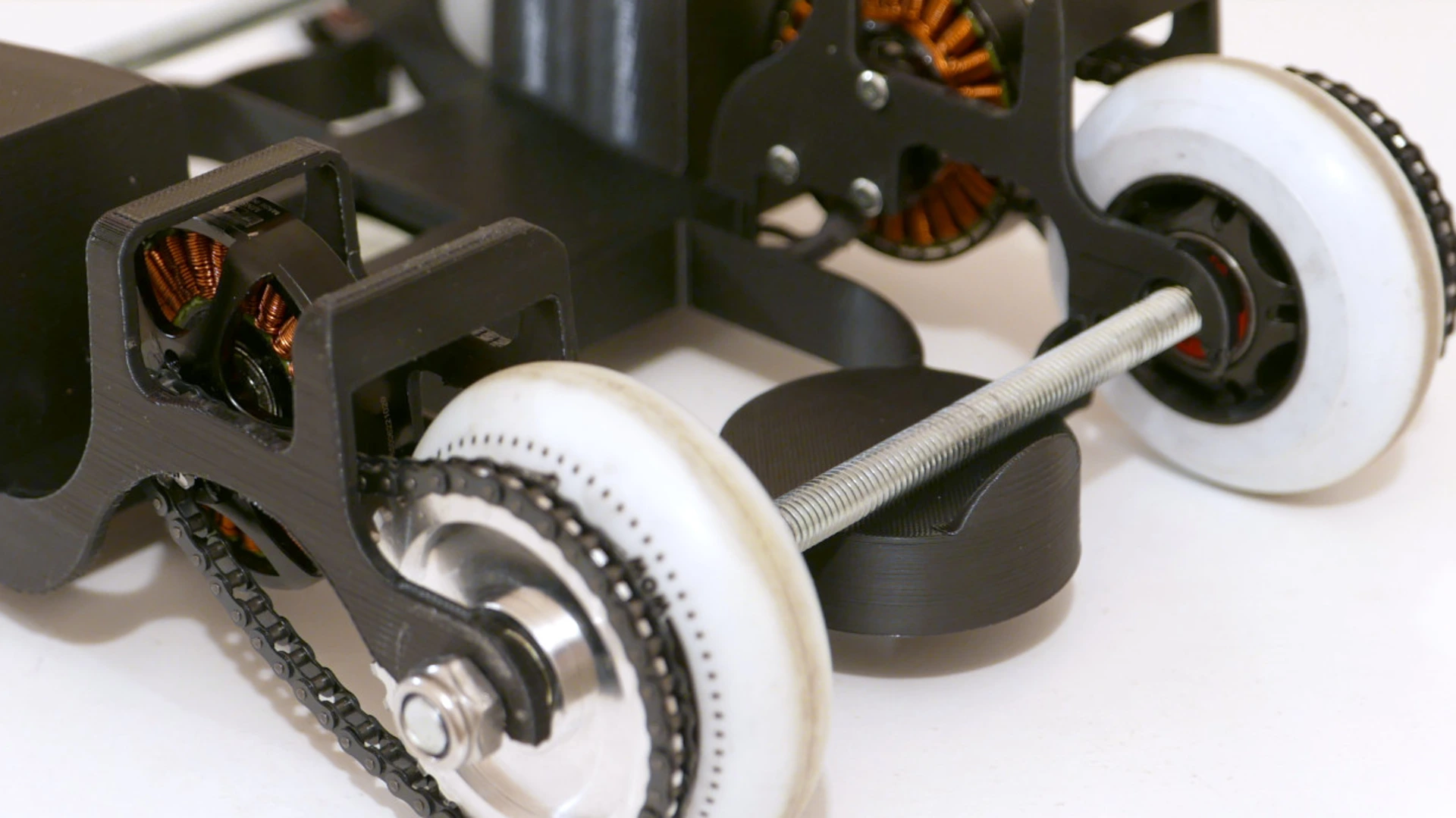
Each KoumKoum has had (spoiler alert) two motors with a KV rating of 320, rated for 16A continuous current, and a 4:1 reduction between the motor and the wheel.
All this technical jargon to say that we achieved our approximately 20kg of pushing force. Our prototype manages to reach that pushing force and goes uphill.
The most unique aspect of the KoumKoum, its shape, with big wheels around the feet, connected to two motors with chains, is what allows such a large pushing force.
What Other Electric Rollerskates Do
While consulting with a Belgian design company, early December 2025, we identified a key limitation of other electric rollerskates: in almost every review on Youtube, the reviewer complains that the rollerskate does not push hard enough. The videos are linked at the end of this blog post (yes, marketing school says to never mention competitors, but here we want to be fully transparent).
We looked carefully at the specs of the competition. Some competitors do not list torque, a pushing force, or comparable information (and they were weak in their Youtube reviews). Others listed numbers that we had to process a bit. For instance, 2 Nm (Nm = Newton-Meters), with a wheel diameter of 10 cm, is a pushing force of 4 kg per skate, so 8 kg in total
So, the KoumKoum pushes more than 2 times more than competing electric rollerskates!
How Much Force Do You Need?
The maths says 20kg, the competition does 8kg. But is 20kg even enough?
While testing the KoumKoum prototype in the field, we observed that while it can go uphill, it wobbles a bit (sometimes accelerates, sometimes decelerates), as the user balances themselves on it. So, the performance is there, but not the feel.
And everyday commuters deserve to feel comfortable and safe on their KoumKoum.
So we went to our motor manufacturer and asked for a motor with twice the pushing force. It is a few grams heavier, and the added pushing force comes at the cost of a slightly lower efficiency (about 5% at full speed), but we received the motor.
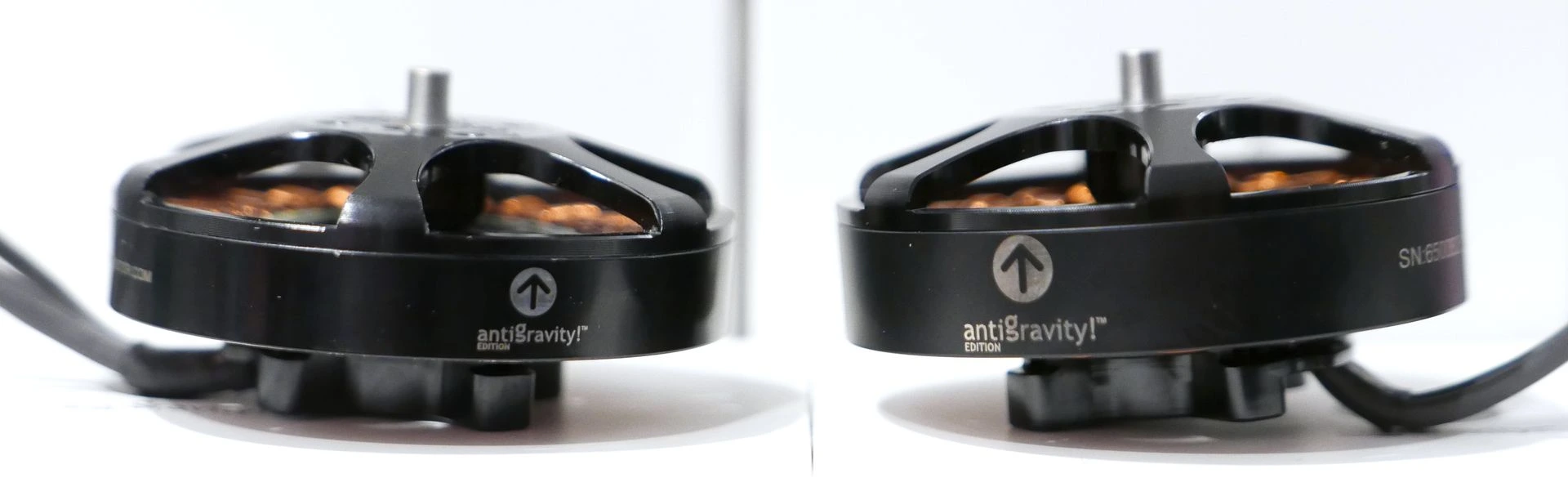
On the left: the KV320 motor that pushes 20kg across two KoumKoums. On the right, the slightly bigger KV170 motor that pushes 37kg across two KoumKoums (the lower the KV, the more it pushes).
So, now, the KoumKoum is able to push you forwards with a maximum force of 37kg across the two KoumKoums. The same applies to braking. While the KoumKoum could brake over 2-3 meters before, it can now stop in about 1 meter with a skilled rider.
Can't e-scooters push 37kg too?
Now that the KoumKoum pushes uphill 4.5 times more than other electric rollerskates, it enters the power range of e-scooters.
We analyzed the specifications of a few common e-scooters, and found that the cheap ones (300-400€) have a pushing force of about 13 kg. Medium ones (about 600€) have a pushing force of 30kg to 40kg, so where the KoumKoum now lies. And big and expensive e-scooters, above 1000€, may have a pushing force up to 97kg.
Bonus: we looked at electric bicycles, they have a pushing force between 20kg (common models) and 30kg (expensive models). Hoverboards and Monowheels have a pushing force of about 30kg too.
So, the KoumKoum now goes uphill just as well as bigger and more expensive e-scooters, and more than an electric bicycle or any other electric rollerskate.
Youtube Reviews
Here are the Youtube reviews that point at the lack (but importance) of pushing force.